
Resources for all students
Free resources for learning Latin, wherever you study. The best way to improve at Latin is to read more Latin, so start there.
Reading · Translation practice · Escape rooms · Grammar · Dictionaries · AP Latin
Reading

myclc.co.uk
Every Cambridge Latin Course story online, stage by stage, with vocabulary help built in. Read ahead, reread a story you found hard, or catch up on one you missed.
Legentibus
An app full of easy Latin stories and books, with audio and tap-to-translate words, graded from beginner to advanced. There are free books and a 3-day trial; otherwise it is $9.99 a month.
More to read
- The Latin Library: free texts of almost every Roman author, for when you are ready for the real thing.
- Latinitium: short Latin readings, audio and videos for learners.
Translation practice

Latin sentence practice →
Choose your textbook (Cambridge Latin Course, Wheelock, Suburani, Latin for the New Millennium, Lingua Latina, Ecce Romani or Athenaze for Greek) and translate sentences that use only the vocabulary and grammar you have met so far. Your answers are checked as you go.
Escape rooms
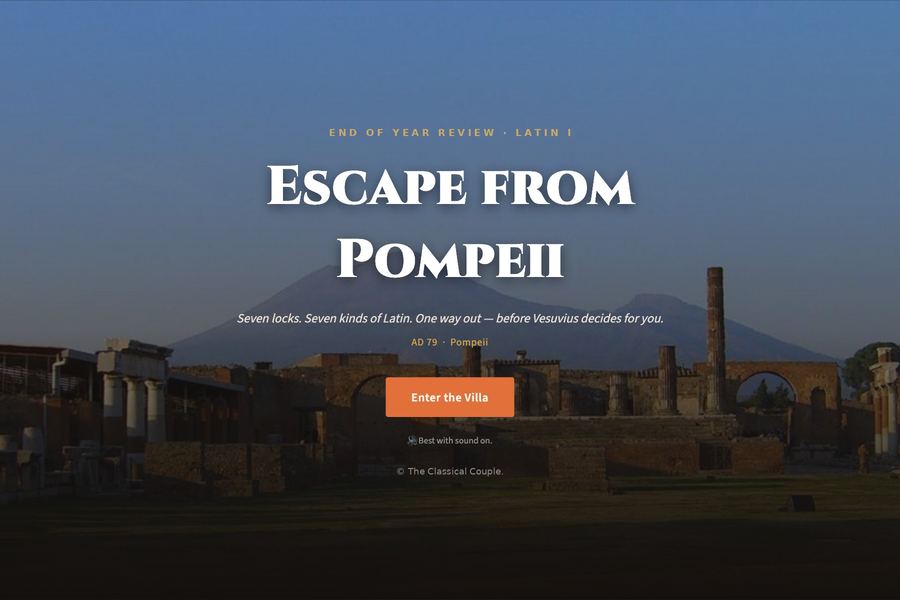
 Locked Lessons
Escape rooms for a classical education →
Digital escape rooms in Latin and Greek: crack the codes and solve the puzzles to escape, using the Latin you know. Rooms follow the Cambridge Latin Course and Athenaze, with AP® Virgil and Pliny rooms too. Ask your teacher for a class link.
Grammar

- Latin 101 (The Latin Library): clear, short explanations of the basics.
- Latin Tutorial: short videos explaining Latin grammar, one topic at a time.
- Allen and Greenough's Latin Grammar: the full reference grammar, for looking things up.
Dictionaries

- Logeion (University of Chicago): look up any Latin or Greek word in several dictionaries at once. Also a free phone app.
- Latinitium dictionaries: searchable Lewis & Short (Latin to English) and Smith & Hall (English to Latin), handy when you write in Latin too.
- Whitaker's Words: type in any form of a word (for example portaverant) and it tells you what it is.
AP Latin: Virgil and Pliny

Virgil
- Interlinear texts (the Latin with an English translation under every word), for every AP passage:
1.1–331.88–107, 496–5122.40–562.201–2494.74–89, 165–1974.305–3616.450–4766.788–800, 847–8537.45–587.783–81711.532–59412.791–82812.919–952
- All the passages in English: a literal translation of every AP passage
- Steadman's Aeneid: every AP passage with vocabulary and notes (PDF)
- Aeneid selections with notes and vocabulary (Dickinson College Commentaries)
- Background to the Aeneid (slides)
- Scansion: the basic rules · slides · practice on 1.1–11 · Hexameter (scan lines online, with instant feedback)
- Virgil emendations (Lapis)
Pliny
- Interlinear texts (the Latin with an English translation under every word):
6.46.76.16 & 6.207.2710.510.610.710.3710.90
- Steadman's Pliny: the letters with vocabulary and notes (PDF)
- All the letters in English
- Pliny emendations (Lapis)
- A Pliny Notebook (Olimpi, PDF)
The exam and the course project
- AP Latin Course and Exam Description (College Board): what is on the syllabus and how the exam works
- 2026–27 project passages: student exercises (Bolchazy-Carducci, free PDF): Lucretius, Seneca's Letters 3.2–3, Regensburg Poem 46 and John of Salisbury's Policraticus 5.8.1–2. Your teacher has the official College Board text of the passages.
Images: Virgil Mosaic, Bardo Museum, photo by David Bjorgen, CC BY-SA 3.0 · Lawrence Alma-Tadema, A Reading from Homer (1885), public domain · Roman writing tablet and stylus, City of London, CC0 · Roman school relief from Neumagen (cast), photo by Shakko, CC BY-SA 3.0 · Vittore Carpaccio, The Vision of St Augustine (c. 1502), public domain · Vergilius Vaticanus: Aeneas and the Sibyl (5th century), public domain.


